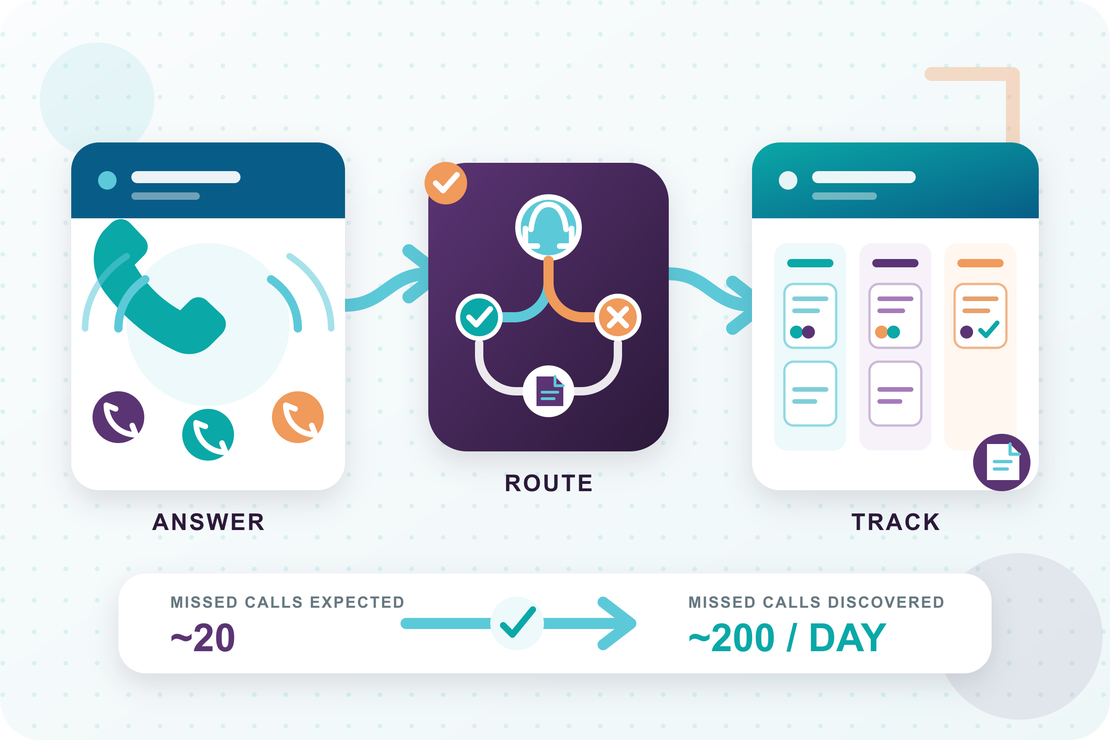
A healthcare organization believed approximately 20 incoming calls were being missed each day. A redesigned intake and follow-up workflow revealed that the actual number was closer to 200, and gave leadership the visibility needed to address it.
The client’s identity and certain identifying details have been withheld. The challenge, work performed, and results remain materially accurate.
Client
A healthcare organization whose medical assistants balanced incoming calls with patient-facing and administrative responsibilities.
Challenge
Leadership did not want dependable phone coverage to depend on medical assistants being available. The organization also lacked a consistent way to determine:
- Why someone was calling
- Which department needed to respond
- Whether a transfer succeeded
- Who was responsible for follow-up
- Whether the request was ultimately handled
The organization estimated that approximately 20 calls per day were being missed, but it had no reliable process for measuring the problem or tracking what happened afterward.
Approach
Diverse Technology began by redesigning the call-handling process.
A contracted answering service became the first point of contact for incoming calls. Its representatives used a documented routing flow to identify the caller’s needs, determine the appropriate department, and attempt to transfer the call to the correct team.
Regardless of whether the transfer succeeded, the answering service documented the interaction using a web form developed within Microsoft 365.
Solution
Each form submission automatically created a task in Microsoft Planner containing:
- Caller information
- The requested department
- The transfer outcome
- The employees responsible for follow-up
- The appropriate workflow bucket
- A defined due date
- A call-handling checklist
- Space for continued, documented notes
Tasks were automatically categorized and assigned according to the organization’s call-handling rules. This gave every request an owner while providing leadership with a shared view of transferred, unresolved, and completed calls.
Discovery
Once calls were consistently captured, the organization discovered that approximately 200 calls per day were going unanswered by the office, roughly ten times the original estimate.
The new workflow replaced assumptions with measurable information. Leadership could identify call volume, transfer outcomes, outstanding work, and recurring handling problems. This supported targeted policy changes and improvements to internal follow-up practices.
Continued Improvement
The call-handling workflow became the foundation for managing additional inbound communications.
Diverse Technology extended the same structured intake, routing, assignment, and follow-up approach to other channels, including website forms. This brought more incoming requests into a consistent process instead of leaving each communication channel dependent on separate inboxes or informal handoffs.
When the organization later implemented Salesforce, Diverse Technology integrated these workflows with the new platform. Call activity, website submissions, ownership, and follow-up information could then become part of the organization’s broader customer relationship system.
Results
Results
The completed engagement:
- Shifted primary call coverage from the availability of medical assistants to a dedicated answering service
- Created an accountable workflow with documented routing, automatic assignment, deadlines, and follow-up tracking
- Revealed that unanswered call volume was nearly ten times higher than leadership had estimated
- Provided the visibility needed to identify handling problems and make informed policy and process changes
- Extended the intake model to website forms and other communication channels before integrating it with Salesforce
What began as a concern about telephone coverage ultimately became a broader improvement in operational visibility, accountability, and follow-through.